
The Homebuyer’s Corner
What Tariffs and Economic Uncertainty Mean for Mortgage Rates in 2026
Written by Armando Novelo, NMLS 237243, a mortgage loan officer in West Covina with over 20 years of experience helping Southern California buyers.
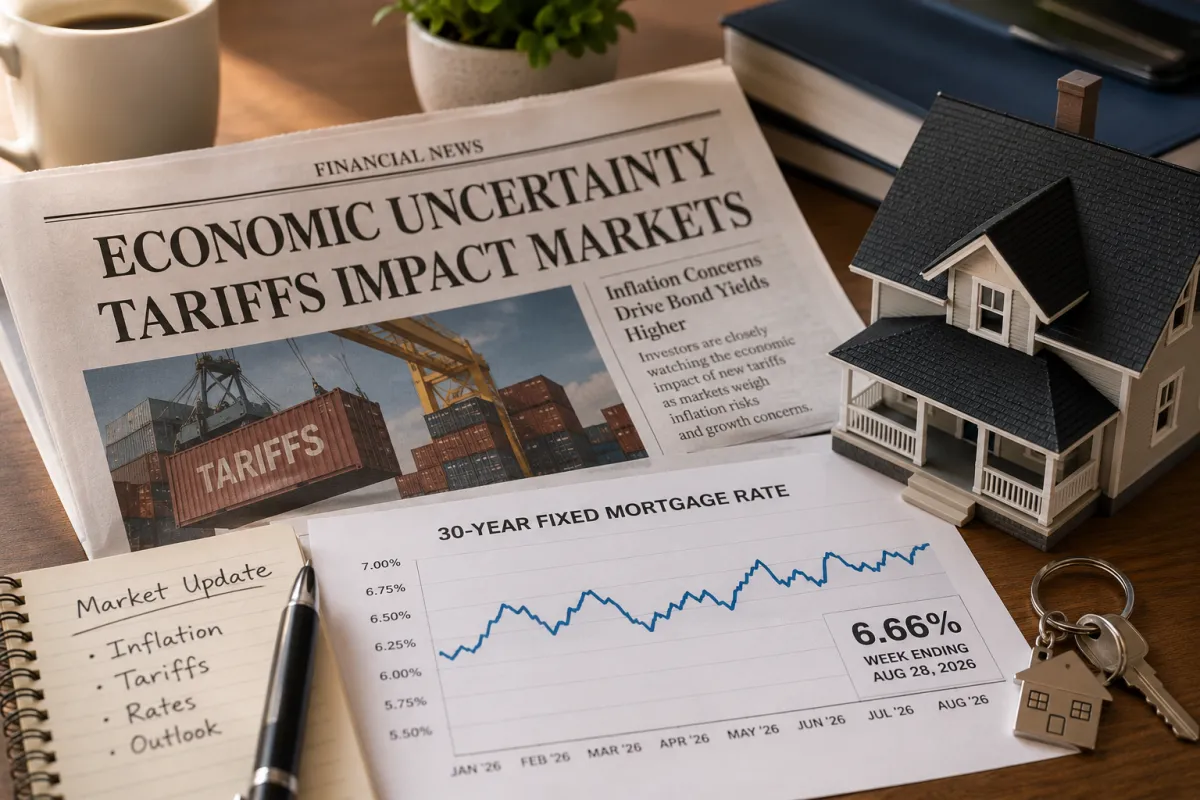
Mortgage rates are not moving in a straight line in 2026 and if you have been watching them week to week trying to figure out when to lock, you already know how disorienting it has been. One week they dip. The next week they jump back up. The week after that they flatten. No clean trend. No obvious signal. Just volatility.
Tariffs are a big part of why.
As of the week ending August 28, 2026, the 30-year fixed rate mortgage was averaging 6.66 percent. That is up from where rates briefly touched earlier in the year and it reflects a market that is genuinely unsettled right now. The Mortgage Bankers Association projects rates settling between 6.1 and 6.3 percent by the end of 2026. Whether that happens depends significantly on what the economy does next and what the bond market decides to believe about inflation.
Understanding the mechanics behind this is more useful than watching the daily rate ticker. Here is what is actually going on.
Tariffs and Inflation: The Connection Most Buyers Miss
Tariffs are taxes on imported goods. When the cost of imported materials goes up, the cost of a lot of things goes up with them. Building materials, appliances, electronics, consumer goods. That price pressure feeds into inflation.
Mortgage rates track the bond market closely, and the bond market is extremely sensitive to inflation expectations. When investors believe inflation is rising or going to stay elevated, they demand higher returns on bonds to protect against the erosion of purchasing power. Higher bond yields mean higher mortgage rates.
The Yale Budget Lab projected that the tariff structure in place as of April 2026 could raise near-term consumer prices and add pressure to inflation measures. That matters directly for buyers because persistent inflation reduces the Federal Reserve's room to cut rates, which keeps mortgage rates elevated longer than they might otherwise be.
The connection is not always immediate or linear. But it is real, and in 2026 it is one of the reasons rates have been harder to predict than usual.
Why Rates Are Going Both Directions at the Same Time
Here is the part that explains the volatility and why even careful rate watchers have been confused this year.
Tariffs do two competing things to the economy simultaneously. They raise prices, which is inflationary and pushes rates up. And they slow economic growth, which is deflationary and creates pressure for rates to come down. Both signals are hitting the bond market at the same time.
When recession fears dominate the news cycle, bond investors flee to safety. They buy Treasury bonds. Bond prices go up, yields go down, and mortgage rates dip. Then an inflation data release comes out hotter than expected, investors sell bonds, yields rise, and mortgage rates jump back up. This has been the pattern throughout 2026. One week down fifteen basis points, the next week up twenty.
This is not unusual behavior during periods of genuine economic uncertainty. But it does mean that anyone who tells you they know exactly where rates are going in the next 60 days is either guessing or selling something. The honest answer right now is that the direction is uncertain and the range is real.
What This Means for New Construction in the SGV
Tariffs affect homebuyers in a second way that is less talked about but just as relevant in a market like the San Gabriel Valley.
Tariffs on imported building materials, lumber, steel, and aluminum, raise construction costs. When it costs more to build, builders either absorb the loss or pass it to buyers through higher prices. More often they pass it on. That dynamic reduces new construction supply because some projects stop penciling out at higher material costs, which puts more pressure on existing home inventory and keeps prices from softening the way buyers might otherwise hope.
For SGV buyers who are considering new construction or a renovation loan on a fixer, this is worth factoring into the budget conversation before you go into contract. Material cost assumptions that were accurate six months ago may not reflect what contractors are quoting today.
What SGV Buyers Should Actually Do With This Information
The temptation when rates are volatile is to wait for clarity. The problem is that clarity may not come on a schedule that is useful to you. A rate environment that looks uncertain in September 2026 could look the same in January 2027 for entirely different reasons.
The more productive approach is to make a decision based on your specific situation rather than on a market you cannot control.
If you are within 60 to 90 days of closing, locking sooner rather than later reduces your exposure to the kind of week-to-week volatility we have been seeing. Rate locks exist precisely for this environment. You are not trying to catch the bottom. You are protecting a number that works for your budget.
If you are still in the shopping phase and your budget works at current rates, the case for waiting on rates to come down before buying is essentially a bet that rates will drop enough before prices move further to make the delay worthwhile. In a supply-constrained market like the SGV, that bet has not historically paid off for buyers who stayed on the sideline.
If you are a current homeowner thinking about a refinance, the range the Mortgage Bankers Association is projecting for the end of 2026 is modestly below where rates are today. Whether a refinance pencils out for your specific situation depends on your current rate, your loan balance, and your break-even timeline. We covered exactly how to run that calculation in this article, in the break-even formula section.
The One Thing That Does Not Change in a Volatile Rate Environment
Your personal financial picture.
Rates move. Your credit score, your income, your savings, and your debt load are things you can actually control. In a volatile market, buyers who have the strongest financial profiles have the most flexibility. They can lock confidently. They can move quickly when the right home comes along. They have options that buyers who are still trying to get their financial house in order simply do not have.
If rates settle toward 6.1 to 6.3 percent by year end as the Mortgage Bankers Association projects, buyers who have been preparing will be ready to act when that window opens. Buyers who have been waiting for rates to move before they start preparing will be starting from scratch in a window that may close quickly.
The market uncertainty is real. Your response to it is something you actually get to choose.
Armando Novelo, NMLS 237243, is a mortgage loan officer at Super Mortgage Bros, powered by Golden Empire Mortgage. He has been helping Southern California buyers and homeowners since 2002. His office is located in West Covina, CA.

Article Published: September 3, 2026
Links
Contact
Armando Novelo
NMLS 237243
Super Mortgage Bros
1900 W. Garvey Ave S. #100
West Covina, CA 91790
Phone: (626) 200-1838
I agree to be contacted by Super Mortgage Bros via call, email and text. To opt out, you can reply “stop” at any time or click the unsubscribe link in the emails. Message and date rates may apply.
Message frequency varies
© 2026 Super Mortgage Bros. Super Mortgage Bros. | All Rights Reserved | Licensed by the Department of Financial Protection and Innovation under the California Residential Mortgage Lending Act. Golden Empire Mortgage, Inc. ("GEM") [NMLS ID No. 2427] is a California corporation whose principal business office is located at 1200 Discovery Drive, Ste. 300, Bakersfield, California 93309. GEM is a residential mortgage lender and servicer Licensed by the Department of Financial Protection and Innovation under the California Residential Mortgage Lending Act. under license no. 413-0360. https://www.nmlsconsumeraccess.org