
The Homebuyer’s Corner
How Are Mortgage Interest Rates Actually Set?
Written by Armando Novelo, NMLS 237243, a mortgage loan officer in West Covina with over 20 years of experience helping Southern California buyers.
Yes.
Mortgage rates are not set by your lender. They come from the bond market, inflation expectations, and investor demand, and they change daily, sometimes hourly, in response to information your lender has no control over. Understanding that one fact removes most of the confusion and anxiety buyers carry around about rates.
Here is how it actually works.
The Bond Market Is Where Rates Start
When a lender makes a mortgage loan, they do not typically hold that loan on their books forever. They bundle it with thousands of other loans and sell the bundle as a mortgage-backed security, a type of bond, to investors. Those investors, pension funds, insurance companies, foreign governments, are buying the right to receive the monthly mortgage payments from all those homeowners.
The rate those investors demand in exchange for buying that bond is the foundation of your mortgage rate. When investors want more mortgage bonds, they accept lower returns and rates fall. When investors are nervous about the economy, inflation, or global instability, they demand higher returns to take on that risk and rates rise.
This happens in real time. Your lender is not picking a number in a back room. They are looking at what the bond market is doing that morning and pricing accordingly. On a volatile week, the rate you are quoted Monday morning may be meaningfully different from what you would have been quoted Friday afternoon.
Inflation Is the Single Biggest Driver
Inflation erodes the purchasing power of money over time. If inflation is running at 4 percent annually and a bond pays 3 percent, the investor is actually losing ground in real terms. So when inflation is elevated, investors demand higher yields to protect themselves, and mortgage rates move up with them.
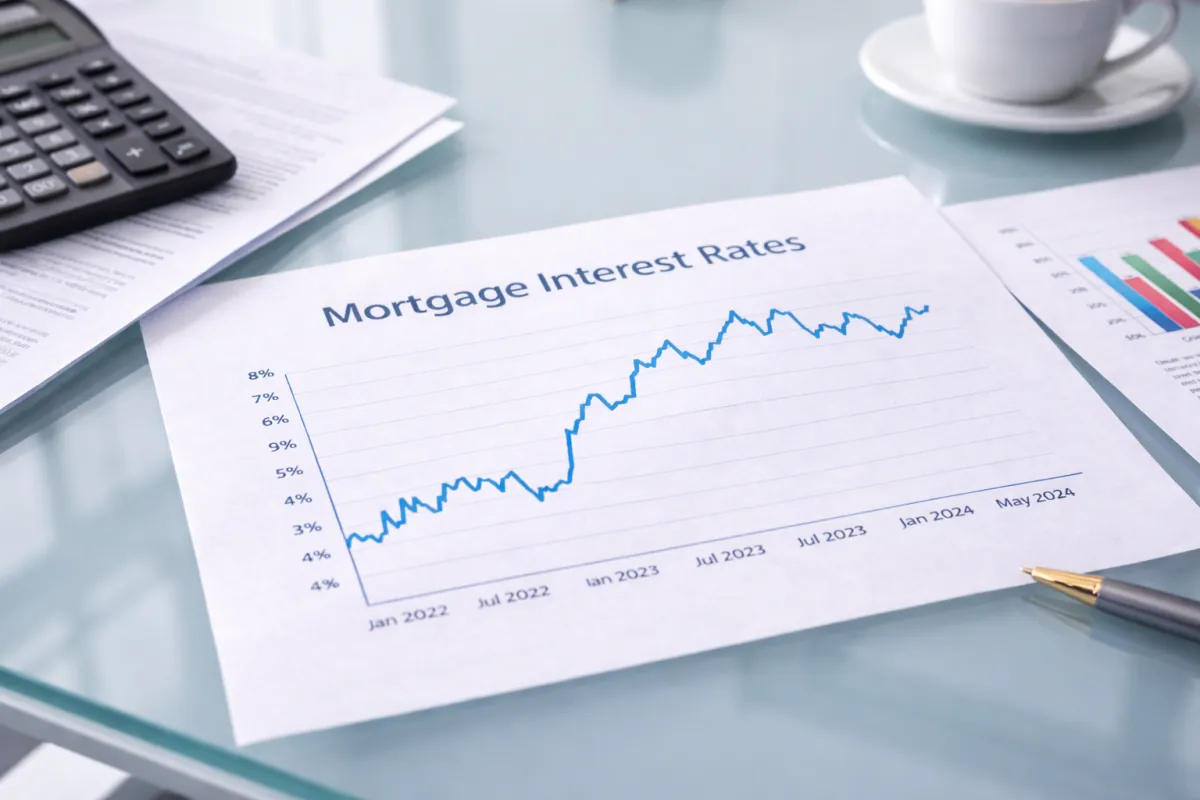
When inflation cools, investors are willing to accept lower returns and rates have room to settle. This is why the period from 2021 to 2023 saw rates climb so dramatically. Inflation ran well above target and the bond market repriced accordingly.
Here is the practical implication. When you hear economic news about the Consumer Price Index, the PCE inflation gauge, or jobs data, pay attention. Strong jobs numbers or higher-than-expected inflation typically push rates up. Weak jobs data or cooling inflation typically creates room for rates to ease. The connection between those reports and what you get quoted is direct, even if it does not always feel that way.
The Federal Reserve and the Common Misconception
Almost every buyer I talk to believes the Fed sets mortgage rates. It does not, at least not directly, and understanding the distinction matters.
The Federal Reserve controls the federal funds rate, which is the overnight rate at which banks lend money to each other. When the Fed raises that rate, it becomes more expensive for banks to borrow and that ripples through the economy. When the Fed cuts it, borrowing costs across the financial system generally ease.
Mortgage rates track the 10-year Treasury yield much more closely than they track the federal funds rate. The 10-year Treasury is a longer-duration bond and mortgage rates live in a similar neighborhood.
What makes this confusing is that Fed decisions influence investor expectations about inflation and economic growth, which in turn affect the 10-year Treasury, which then moves mortgage rates. So the Fed has an indirect but real influence. Just not the direct dial most people assume.
This is why you can see the Fed cut rates and mortgage rates go up the same day. The market was already pricing in future inflation expectations that moved in the opposite direction of the cut. It feels counterintuitive but it is not.
What Your Loan Adds on Top
The bond market establishes the baseline rate environment for a given day. Where you land inside that environment depends on your specific loan profile.
Credit score is the biggest personal factor. On a $700,000 loan, the difference between a 640 credit score and a 760 score can be 0.5 to 0.75 percent in rate depending on the program. On that loan amount, 0.5 percent is roughly $230 a month in payment difference. That adds up to nearly $2,800 a year and close to $83,000 over a 30-year term. Your credit score is not a minor detail.
Down payment affects loan-to-value which affects risk which affects pricing. A buyer putting 20 percent down represents less risk to the investor than a buyer putting 3.5 percent down. The pricing reflects that difference.
Loan type matters too. FHA loans, conventional loans, jumbo loans, and investment property loans all carry different risk profiles and are priced differently even on the same day in the same market. We covered how FHA and conventional loans compare in this article.
Occupancy type is the last layer. A loan on a primary residence is priced more favorably than the same loan on a second home or investment property because owner-occupants have a stronger incentive to maintain their payments. DSCR and investment property loans carry additional pricing premium for that reason.
Rate Locks and Why Timing Matters
When you lock a rate, you are freezing the market at that specific moment for a set period, typically 30 to 60 days depending on the lender and program. If rates rise after your lock, you are protected. If rates fall, you do not automatically benefit unless your lender offers a float-down option, which some do under specific conditions.
The decision about when to lock is real and it has financial consequences. Locking too early on a long escrow means paying for extended lock coverage, which has a cost. Locking too late in a rising rate environment means watching your payment increase before you close. If you are also weighing whether to pay points upfront to buy down your rate before locking, this article walks through exactly when that trade-off makes sense.
I do not try to predict rates. Nobody can do that reliably. What I help clients do is understand the risk in each direction and make a decision based on their specific timeline and how much payment variability they can absorb while the loan is in process.
Why Rates Feel Random When You Are Watching Them
A jobs report that comes in stronger than expected can push rates up within minutes. An inflation print that surprises to the downside can bring them down. A geopolitical event halfway around the world can move mortgage rates in California before the news cycle catches up.
This is disorienting for buyers who are watching rates daily hoping to time the market. The volatility is real but the underlying direction tends to be clearer over weeks and months than it is over hours and days.
The practical lesson I have learned after more than two decades in this business is that buyers who focus on whether today's rate works for their budget make better decisions than buyers who are waiting for a rate that may or may not come. You can always refinance if rates move significantly lower. You cannot get back the years of equity building you missed while you waited.
I had a buyer in the SGV a few years back who postponed his purchase three separate times waiting for rates to drop. Each time he waited, home prices in the neighborhoods he was targeting had moved. By the time he finally bought, he paid more for a similar home than he would have the first time he had been ready, and the rate he got was not materially better than what was available when he first started looking. That is not a knock on him. He was doing what felt rational. But the math did not work out the way he expected.
What You Can Actually Control
You cannot control what the bond market does. You cannot predict what the Fed will do next or how inflation will print next month.
You can control your credit score. You can control how much you save for a down payment and what that does to your loan-to-value ratio. You can control the loan type and occupancy structure that fits your situation. You can control when you lock once you are under contract.
Focusing on those variables gives you more leverage over your rate than watching the news every morning hoping for good news.
Understanding how rates work is not about trying to game the system. It is about removing the mystery so you can make a clear-eyed decision about when the market works for your situation and when it does not.
Armando Novelo, NMLS 237243, is a mortgage loan officer at Super Mortgage Bros, powered by Golden Empire Mortgage. He has been helping Southern California buyers and homeowners since 2002. His office is located in West Covina, CA.
For more info, join my email list.
Article Published: July 23, 2026

Links
Contact
Armando Novelo
NMLS 237243
Super Mortgage Bros
1900 W. Garvey Ave S. #100
West Covina, CA 91790
Phone: (626) 200-1838
I agree to be contacted by Super Mortgage Bros via call, email and text. To opt out, you can reply “stop” at any time or click the unsubscribe link in the emails. Message and date rates may apply.
Message frequency varies
© 2026 Super Mortgage Bros. Super Mortgage Bros. | All Rights Reserved | Licensed by the Department of Financial Protection and Innovation under the California Residential Mortgage Lending Act. Golden Empire Mortgage, Inc. ("GEM") [NMLS ID No. 2427] is a California corporation whose principal business office is located at 1200 Discovery Drive, Ste. 300, Bakersfield, California 93309. GEM is a residential mortgage lender and servicer Licensed by the Department of Financial Protection and Innovation under the California Residential Mortgage Lending Act. under license no. 413-0360. https://www.nmlsconsumeraccess.org