
The Homebuyer’s Corner
If I Buy a House Now and Rates Drop Later, How Soon Can I Refinance?
Written by Armando Novelo, NMLS 237243, a mortgage loan officer in West Covina with over 20 years of experience helping Southern California buyers.
In most cases you can refinance as soon as the math makes sense. There is no standard waiting period built into a conventional or FHA mortgage. If rates drop the month after you close and a refinance pencils out, nothing is stopping you from doing it.
That surprises a lot of buyers. They assume there is a mandatory waiting period, some rule that locks them in for a year or two before they can do anything. For most loans that assumption is wrong. And it is one of the things holding buyers back from pulling the trigger in today's rate environment.
Do Loans Have Prepayment Penalties?
Most do not. Prepayment penalties on standard conventional and FHA loans are extremely rare today. Federal regulations put significant restrictions on prepayment penalties after 2008 and for the vast majority of purchase loans being written right now, you are free to refinance, sell, or pay off the loan at any point without a financial penalty for doing so.
There are exceptions. Certain non-QM loans, some portfolio products, and a handful of specialty programs still include prepayment penalty clauses. If you ever take a loan outside conventional or FHA guidelines, ask specifically whether a prepayment penalty applies and what the terms are. It should be disclosed clearly in your loan documents either way.
For almost everyone reading this, the waiting period concern is not the real question. The real question is whether refinancing makes financial sense when the time comes.
The Break-Even Calculation: The Only Number That Actually Matters
Refinancing costs money upfront. Lender fees, title fees, escrow, appraisal, prepaid interest. A typical refinance on a California home runs somewhere between $4,000 and $8,000 in closing costs depending on the loan amount and the lender. Some lenders offer no-cost refinances where those costs are rolled into a slightly higher rate instead of paid at closing.
Either way, the refinance has a cost. And that cost needs to be recovered through monthly savings before the refinance actually benefits you.
The formula is simple. Take the total closing cost and divide it by the monthly savings your new payment generates. The result is your break-even point in months.
Here is a real example using SGV numbers.
Say you bought a home in West Covina with a $700,000 loan at 7.0 percent. Your principal and interest payment is approximately $4,657 per month. Rates drop and you can refinance to 6.0 percent. Your new payment would be approximately $4,198 per month. That is a savings of $459 per month.
Your refinance costs $6,000 in closing costs. Divide $6,000 by $459 and your break-even is 13 months. If you plan to keep the loan longer than 13 months after the refinance closes, you come out ahead. If you are selling or refinancing again within 13 months, you do not recoup the cost.
That is the whole calculation. Rate drop size, loan amount, closing cost, monthly savings, months to break even, how long you plan to stay. Run those five numbers and you have your answer.
What a 1 Percent Rate Drop Actually Saves You
This is the scenario most buyers in California are sitting with right now. They bought at 6.5 or 7 percent and want to know what a meaningful rate drop would look like in their pocket.
On a $700,000 loan, a 1 percent rate reduction saves you approximately $450 to $470 per month depending on where the rate lands. That is over $5,500 per year. Over five years that is more than $27,000 in savings, less whatever the refinance cost.
On a $900,000 loan the numbers scale up. A 1 percent drop saves roughly $575 to $600 per month, or nearly $7,000 per year.
Those are real numbers worth paying attention to. They are also why I tell buyers in today's market: do not wait on the sidelines for rates to drop before buying. Buy when the home and the payment work for your life. Refinance when the math tells you to. Those are two separate decisions and treating them as one is how buyers miss out on years of equity building while they wait for a rate that may or may not come.
When Refinancing Makes Sense and When It Does Not
Refinancing makes sense when rates have dropped enough to produce meaningful monthly savings, your break-even timeline is shorter than how long you plan to keep the loan, and your credit and financial profile have stayed strong or improved since you bought.
It generally does not make sense when the rate drop is small and closing costs push your break-even out beyond your realistic hold period, when you are planning to sell or move within the next year or two, or when rolling closing costs into the loan would increase your balance enough to offset the payment savings.
The rate alone does not make the decision. I have seen buyers jump at a refinance to save $80 a month on a loan they were planning to sell out of within 18 months. The math did not work. A lower rate without a break-even analysis is just a number.
The Practical Move Right Now
If you are buying today at current rates, the right move is to buy when the home and the payment make sense for your life, and then watch rates. Not obsessively. Just have a conversation with your lender about what rate level would trigger a refinance worth doing on your specific loan amount. Put a number on it. Then you know exactly what you are watching for and you can make a calm, intentional decision when it happens instead of reacting to headlines.
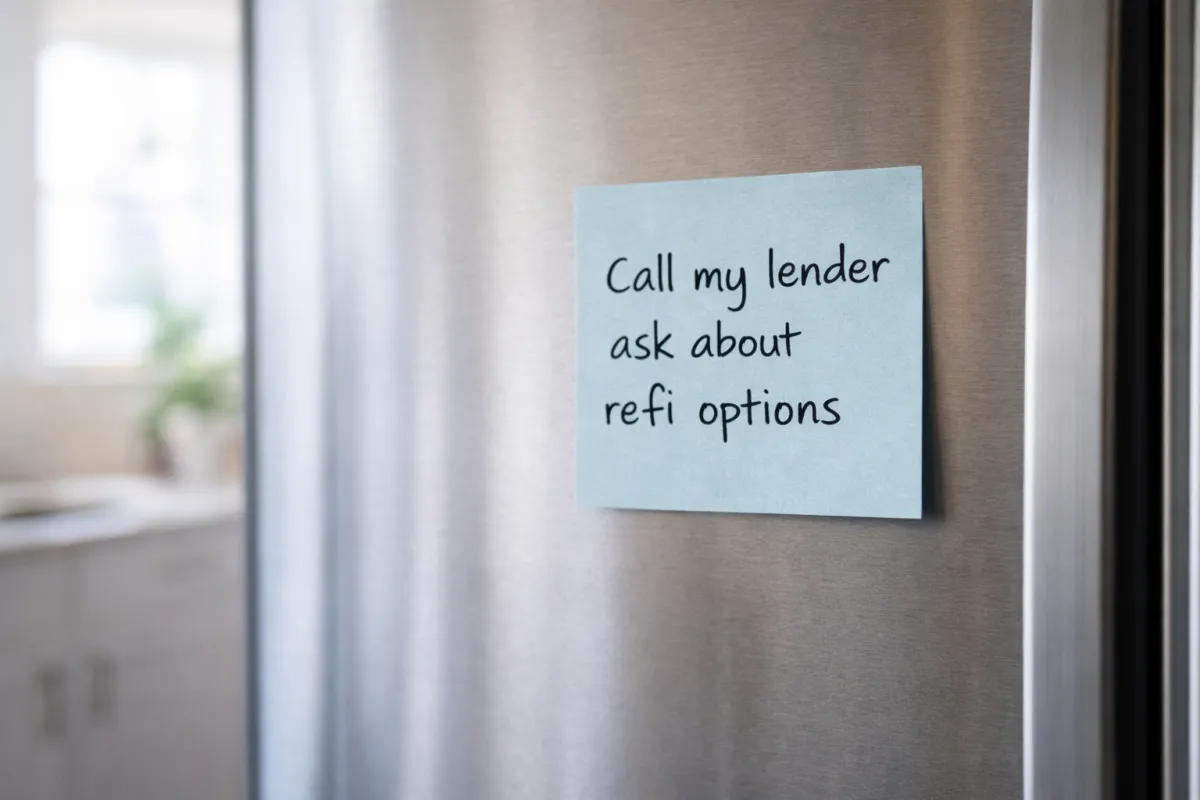
That sticky note on the fridge is not a bad idea. Keep your lender's number somewhere visible. When rates move, you want to be the first call, not the last.
Armando Novelo, NMLS 237243, is a mortgage loan officer at Super Mortgage Bros, powered by Golden Empire Mortgage. He has been helping Southern California buyers and homeowners since 2002. His office is located in West Covina, CA.
For more info, join my email list.
Article Published: May 12, 2026

Links
Contact
Armando Novelo
NMLS 237243
Super Mortgage Bros
1900 W. Garvey Ave S. #100
West Covina, CA 91790
Phone: (626) 200-1838
I agree to be contacted by Super Mortgage Bros via call, email and text. To opt out, you can reply “stop” at any time or click the unsubscribe link in the emails. Message and date rates may apply.
Message frequency varies
© 2026 Super Mortgage Bros. Super Mortgage Bros. | All Rights Reserved | Licensed by the Department of Financial Protection and Innovation under the California Residential Mortgage Lending Act. Golden Empire Mortgage, Inc. ("GEM") [NMLS ID No. 2427] is a California corporation whose principal business office is located at 1200 Discovery Drive, Ste. 300, Bakersfield, California 93309. GEM is a residential mortgage lender and servicer Licensed by the Department of Financial Protection and Innovation under the California Residential Mortgage Lending Act. under license no. 413-0360. https://www.nmlsconsumeraccess.org