
The Homebuyer’s Corner
What Is a 2-1 Mortgage Buydown and Is It Worth It?
Written by Armando Novelo, NMLS 237243, a mortgage loan officer in West Covina with over 20 years of experience helping Southern California buyers.
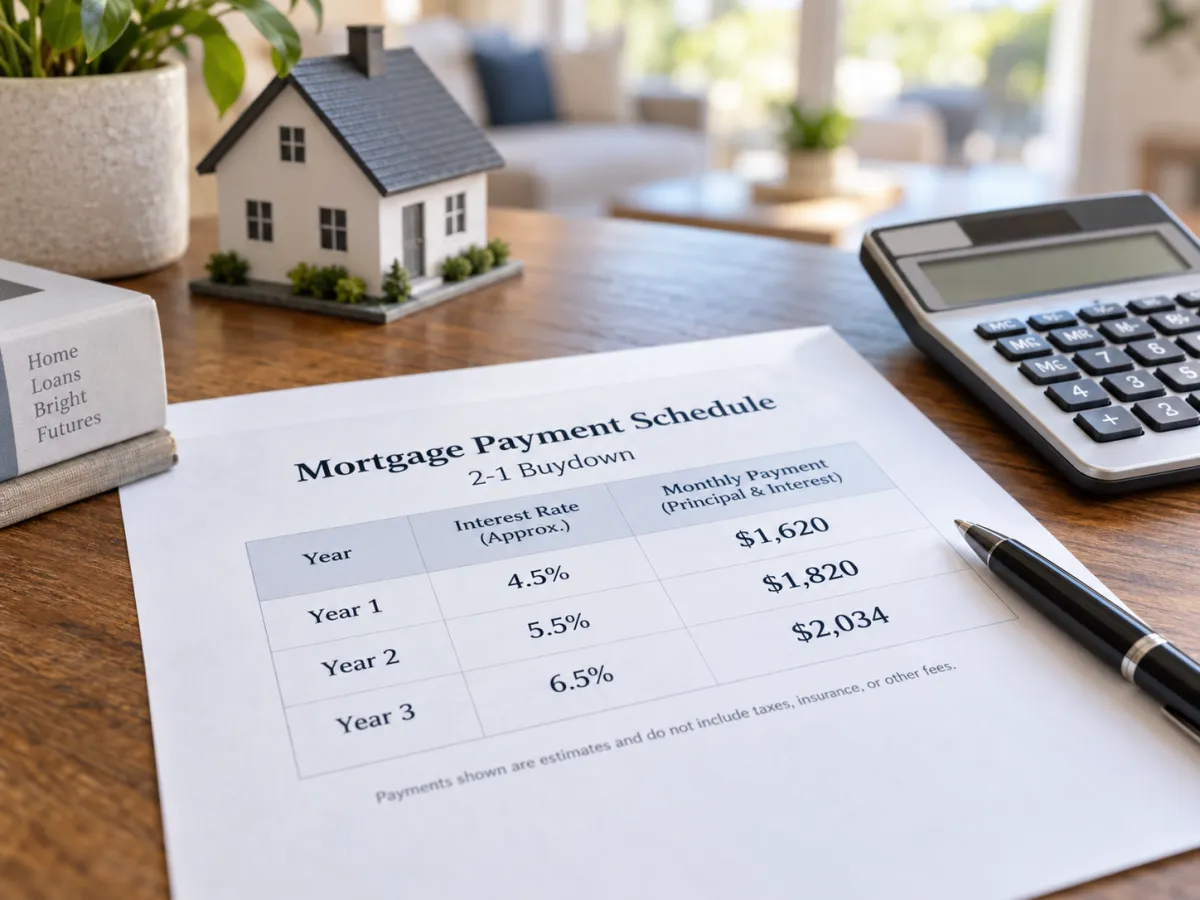
A 2-1 buydown lowers your mortgage payment for the first two years and then returns to the full rate in year three. The first year your payment is calculated as if your rate were two percent lower. The second year one percent lower. The third year and every year after that you are paying the full rate. In most cases the seller, the builder, or another allowed party pays for it at closing through a concession.
It is a legitimate tool. It is also one of the most frequently misunderstood ones. And in a market like the San Gabriel Valley where sellers are negotiating and builders are competing for buyers, it comes up in nearly every new construction conversation I have.
How the Numbers Actually Work
Let me show you what this looks like in real dollars using a loan amount that is realistic for the SGV right now.
On a $700,000 loan at a 6.75 percent note rate, your full principal and interest payment in year three and beyond is approximately $4,540 per month.
In year one, your payment is calculated as if your rate were 4.75 percent. That brings the payment down to approximately $3,651 per month. You are saving roughly $889 per month compared to the full payment.
In year two, your rate is effectively 5.75 percent. Your payment is approximately $4,085 per month. You are saving approximately $455 per month.
In year three your rate snaps back to 6.75 percent and your payment is the full $4,540.
The total monthly savings over the 24-month buydown period on this example is approximately $16,128. That is the amount the seller or builder needs to deposit into an escrow account at closing to fund it. That money gets disbursed monthly to cover the difference between your reduced payment and the full payment until the buydown period ends.
Who Pays for the Buydown and How It Gets Structured
In almost every case it is the seller or builder paying for it, not the buyer. The funds go into a dedicated escrow account at closing and are released monthly to cover the payment difference. The buyer makes the lower payment and the escrow funds cover the rest.
This matters because the buydown is not free money that appears out of nowhere. The seller is choosing to put that money toward a buydown rather than toward a price reduction, closing cost credits, or something else. That is the comparison Armando always runs before recommending it, and it is the most important conversation most buyers are not having when someone puts a buydown in front of them.
You Still Qualify at the Full Rate
This surprises a lot of buyers and it is worth stating clearly. A 2-1 buydown does not change how you qualify for the loan. Lenders underwrite you at the full note rate, not the reduced year-one rate. Your debt-to-income ratio is calculated on the payment you will owe starting in year three.
The buydown improves your actual monthly cash flow during years one and two. It does not help you qualify for a home you otherwise could not afford. If the full year-three payment stretches your budget to the point where it feels uncomfortable, a buydown is not a solution to that problem. It is a delay.
When I present a 2-1 buydown to a buyer I show all three payments from day one. Year one, year two, year three. The full picture. Because what people do not realize until they are in it is that the lower payment is temporary and the full payment is what you are committing to for the life of the loan. We covered how lenders calculate qualification and what debt-to-income ratios mean in this article, specifically in the section on why two buyers with the same income qualify for very different loans.
Is a 2-1 Buydown Worth It? It Depends on This One Question
The buydown is worth it when the seller or builder is paying for it and you plan to stay in the home long enough for the full payment to work in your budget. It is not worth it when you are banking on a refinance to escape the year-three payment.
That is the mistake I see most often. A buyer falls in love with the year-one payment without fully internalizing that rates may not drop enough to refinance before year three arrives. Rates may come down. There is no guarantee they will or that they will fall enough to make the refinance pencil out. If the full payment at today's rate is not something you can comfortably carry, the buydown is a 24-month delay, not a plan.
The more useful question is what else could the seller or builder do with that same money. On a $700,000 purchase, the approximately $16,000 buydown cost could alternatively be applied to permanently buying down your rate, which would lower your payment every month for the life of the loan rather than just for two years. Or it could cover a significant portion of your closing costs, which reduces what you need to bring to the table at closing. We covered exactly how permanent rate buydowns work and when they make more sense than a temporary structure in this article, specifically in the break-even formula section.
I do not automatically recommend the 2-1 buydown just because the first year payment looks better. I compare all three options side by side and show the buyer the full picture before we decide.
What Happens If You Refinance or Sell Before Year Three
If you refinance or pay off the mortgage before the buydown period ends, the remaining funds sitting in the buydown escrow account are applied to the loan payoff. They do not go back to the seller or builder and they do not go back to you in cash. They reduce your loan balance at the time of payoff.
That is worth knowing before you structure a buydown around the assumption that you will definitely refinance in 18 months. Even if the refinance happens on schedule, the unused escrow funds disappear into the payoff rather than staying in your pocket
When I Recommend Looking at a 2-1 Buydown
There are real situations where a 2-1 buydown is the right call.
When a builder or seller is offering it as a concession and the alternative is simply taking a price that is already non-negotiable. When the buyer's income is growing and the year-one and year-two payments provide genuine breathing room during a transition period. When the buyer's plan genuinely does not depend on a refinance and the full year-three payment is solidly within their budget.
In those situations the buydown delivers real value. $889 less per month in year one is not nothing, especially in the first year of homeownership when unexpected expenses tend to show up. We covered the full list of costs new homeowners often underestimate in this article, in the section on maintenance costs that show up sooner than expected.
I worked with a buyer in the SGV who was purchasing a new construction home from a builder offering a 2-1 buydown as a standard incentive. When I ran the comparison, we found that applying the same seller credit toward a permanent rate reduction instead would save her more money over a five-year hold period than the buydown would. She chose the permanent reduction. That is the conversation most buyers in new construction are not having because nobody is running the comparison for them.
Armando Novelo, NMLS 237243, is a mortgage loan officer at Super Mortgage Bros, powered by Golden Empire Mortgage. He has been helping Southern California buyers and homeowners since 2002. His office is located in West Covina, CA.

Article Published: September 15, 2026

Links
Contact
Armando Novelo
NMLS 237243
Super Mortgage Bros
1900 W. Garvey Ave S. #100
West Covina, CA 91790
Phone: (626) 200-1838
I agree to be contacted by Super Mortgage Bros via call, email and text. To opt out, you can reply “stop” at any time or click the unsubscribe link in the emails. Message and date rates may apply.
Message frequency varies
© 2026 Super Mortgage Bros. Super Mortgage Bros. | All Rights Reserved | Licensed by the Department of Financial Protection and Innovation under the California Residential Mortgage Lending Act. Golden Empire Mortgage, Inc. ("GEM") [NMLS ID No. 2427] is a California corporation whose principal business office is located at 1200 Discovery Drive, Ste. 300, Bakersfield, California 93309. GEM is a residential mortgage lender and servicer Licensed by the Department of Financial Protection and Innovation under the California Residential Mortgage Lending Act. under license no. 413-0360. https://www.nmlsconsumeraccess.org