
The Homebuyer’s Corner
Renting vs Buying in the San Gabriel Valley in 2026
Written by Armando Novelo, NMLS 237243, a mortgage loan officer in West Covina with over 20 years of experience helping Southern California buyers.
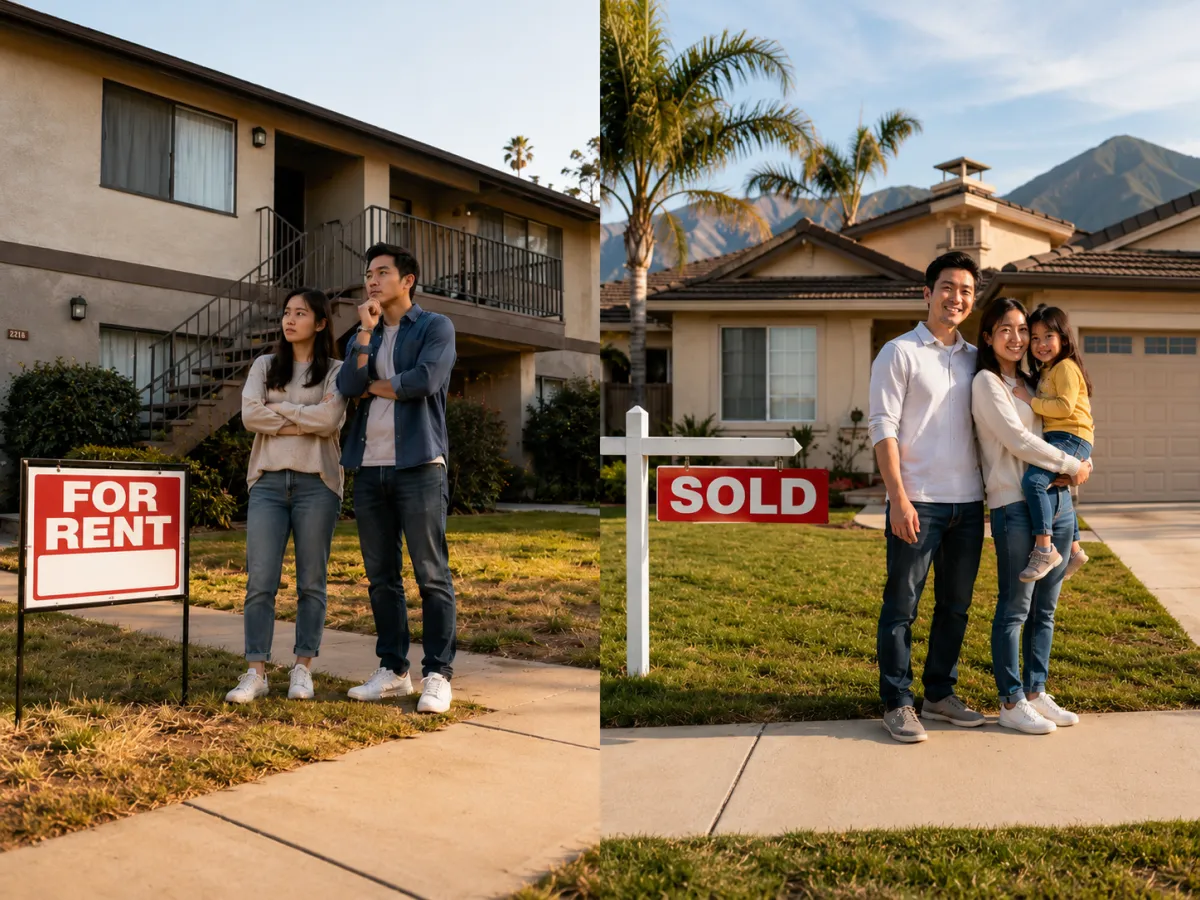
In most cases in the San Gabriel Valley right now, buying wins the math. Not always. Not for everyone. But when you run the actual numbers side by side and account for what renting actually costs over time versus what owning actually builds, the comparison almost never favors waiting as long as most people think it does.
The reason people stay on the fence is not the numbers. It is the fear that the numbers will not work. Most people who believe renting is the smarter choice have never actually sat down and run the comparison with real figures for their specific situation.
This article does that for you.
What Renting in the SGV Actually Costs Right Now
The average rental home in the San Gabriel Valley is running $3,579 per month as of August 2026. For a three-bedroom house or apartment at the more accessible end of the market, you are looking at $2,800 to $3,200 per month depending on the city and condition.
Call it $3,000 a month for this comparison. That is $36,000 per year going to a landlord.
At the end of 12 months, your landlord has $36,000. You have a place to live and a lease renewal coming up. You have zero equity, zero appreciation, zero tax benefit, and zero say in what happens to that property if the owner decides to sell, raise the rent, or move someone else in.
That is not a knock on renters. There are legitimate seasons of life where renting is the right call. But most people in the SGV who have been renting for three, five, or eight years are not there because renting is the better financial decision. They are there because they assumed buying was out of reach and never ran the numbers to find out.
What Buying in the SGV Actually Costs Right Now
At the current West Covina median price of $865,000 with 5 percent down, your loan amount is $821,750. At a 30-year fixed rate of around 6.5 percent, your principal and interest payment is approximately $5,194 per month. Add property taxes at roughly 0.69 percent annually, which is about $498 per month. Add homeowners insurance at approximately $150 per month. Your total housing payment lands around $5,842 per month.
That is $2,842 more per month than the $3,000 rental scenario. On the surface, renting looks cheaper by almost $3,000 a month. That is the number most people stop at and that is exactly why the comparison is misleading when you stop there.
What Buying Gives You That Renting Does Not
Every mortgage payment has two components. Interest, which is the cost of borrowing, and principal, which reduces your loan balance. In the early years of a mortgage the split favors interest. But even in year one on an $821,750 loan at 6.5 percent, you are paying down roughly $1,000 in principal per month. By year five that number is climbing. By year ten it is significantly higher. That is wealth building that has nothing to do with appreciation.
Now add appreciation. The San Gabriel Valley has averaged roughly 5 to 6 percent annual home value growth over the last decade, though markets vary and past performance does not guarantee future results. On an $865,000 home, 5 percent appreciation is $43,250 in year one alone. That is equity you built without making any extra payments, without doing any renovations, simply by owning.
Combined, a buyer in year one on that $865,000 home is building roughly $55,000 in total equity between principal paydown and modest appreciation. The renter built zero.
Over five years the comparison becomes harder to look at if you are the renter.
The Side-by-Side Over Five Years
Let's run it clean.
The renter. $3,000 per month for 60 months is $180,000 paid in rent. Rent in the SGV has been increasing at an average of 3 to 5 percent annually. At 4 percent annual increases, the renter who starts at $3,000 in 2026 is paying approximately $3,650 per month by 2031. Total rent paid over five years at those escalations is closer to $197,000. Net equity built: zero. Net wealth from housing: zero. We cover exactly how those rent increases compound in the article that follows this one, which goes deeper on the 10-year projection.
The buyer. $5,842 per month for 60 months at a blended rate that does not account for any refinancing is $350,520 in total housing payments. Against that, the buyer has built approximately $55,000 to $60,000 in equity in year one alone, growing each subsequent year. Over five years of 5 percent annual appreciation, the home has grown from $865,000 to approximately $1,104,000. The loan balance has dropped from $821,750 to approximately $778,000. Equity position at year five: roughly $326,000. That is the difference between the property value and the remaining balance.
The buyer spent more per month. The buyer built $326,000 in net worth from housing. The renter built zero.
That gap does not mean buying is right for everyone at every moment. It means the "renting is cheaper" calculation is almost never as simple as comparing the monthly payment to the monthly rent.
When Renting Actually Is the Right Call
Honesty requires saying this clearly because the math above is compelling and I do not want it to mislead anyone into a decision that does not fit their life.
Renting makes more sense when your timeline in the area is genuinely short, under two years. When your financial situation needs time to stabilize, credit repair, income growth, debt paydown. When you do not have the down payment or closing costs available and your options would require taking on more financial pressure than your monthly budget can absorb. And when the emotional or logistical reality of homeownership is something you are genuinely not ready for.
None of those are failures. They are honest assessments of where you are. A good lender tells you when the time is right, not just that it is always right. If any of those apply to you, the more useful conversation is what needs to change and how long it realistically takes. That is a 20-minute call, not a five-year wait in the dark.
What the Numbers Cannot Capture
I grew up moving constantly. Different apartments, different cities, different schools. I always felt a little behind, a little off balance, like everyone else already knew something I had not figured out yet.
When my mom finally bought her first home, I went to the same school for a full year for the first time in my life. I caught up. I settled in. I realized I was not behind. I had just been unstable.
That is the thing the spreadsheet does not measure. Homeownership is not just a financial decision. It is a stability decision. It is a decision about where your kids go to school, whether your landlord can sell the property out from under you, whether your rent goes up in January when you were not expecting it, whether you get to paint the walls the color you want.
The financial case for buying in the SGV is real and I have laid it out with real numbers above. But the case that matters most to most families I have worked with over the past two decades is not the equity or the appreciation. It is that they stopped moving. They had somewhere that was theirs. And that changed everything.
That story has a financial punchline too. The equity those families built over five, ten, twenty years became the foundation for everything else. College for their kids. Retirement security. The ability to help their own children buy homes someday.
Stability compounds. So does equity.
What to Do With This Information
If you have been renting in the SGV and wondering whether the math ever tilts toward buying, the answer for most people is yes, and the tipping point is usually closer than they expected.
The next step is running your specific numbers, not a national average, not a back-of-napkin estimate. Your income, your credit, your savings, and which programs are available to help close the gap. That conversation takes about 20 minutes and it produces a real answer rather than an assumption.
For buyers who want to understand what down payment assistance is available in the SGV right now to reduce the upfront barrier, this article covers the full landscape, specifically in the section on city, county, and state programs and how they stack. And for buyers who are not sure where to start or whether they are ready to begin the process at all, this article explains exactly why starting earlier than you think makes a real difference, specifically in the section on what loan programs have rules that take time to meet.
The math is on the table. Now you just have to decide if you are ready to run it on your own situation.
Armando Novelo, NMLS 237243, is a mortgage loan officer at Super Mortgage Bros, powered by Golden Empire Mortgage. He has been helping Southern California buyers and homeowners since 2002. His office is located in West Covina, CA.

Article Published: August 25, 2026

Links
Contact
Armando Novelo
NMLS 237243
Super Mortgage Bros
1900 W. Garvey Ave S. #100
West Covina, CA 91790
Phone: (626) 200-1838
I agree to be contacted by Super Mortgage Bros via call, email and text. To opt out, you can reply “stop” at any time or click the unsubscribe link in the emails. Message and date rates may apply.
Message frequency varies
© 2026 Super Mortgage Bros. Super Mortgage Bros. | All Rights Reserved | Licensed by the Department of Financial Protection and Innovation under the California Residential Mortgage Lending Act. Golden Empire Mortgage, Inc. ("GEM") [NMLS ID No. 2427] is a California corporation whose principal business office is located at 1200 Discovery Drive, Ste. 300, Bakersfield, California 93309. GEM is a residential mortgage lender and servicer Licensed by the Department of Financial Protection and Innovation under the California Residential Mortgage Lending Act. under license no. 413-0360. https://www.nmlsconsumeraccess.org