
The Homebuyer’s Corner
What Extra Costs Should First-Time Buyers Plan For Besides the Down Payment?
Written by Armando Novelo, NMLS 237243, a mortgage loan officer in West Covina with over 20 years of experience helping Southern California buyers.
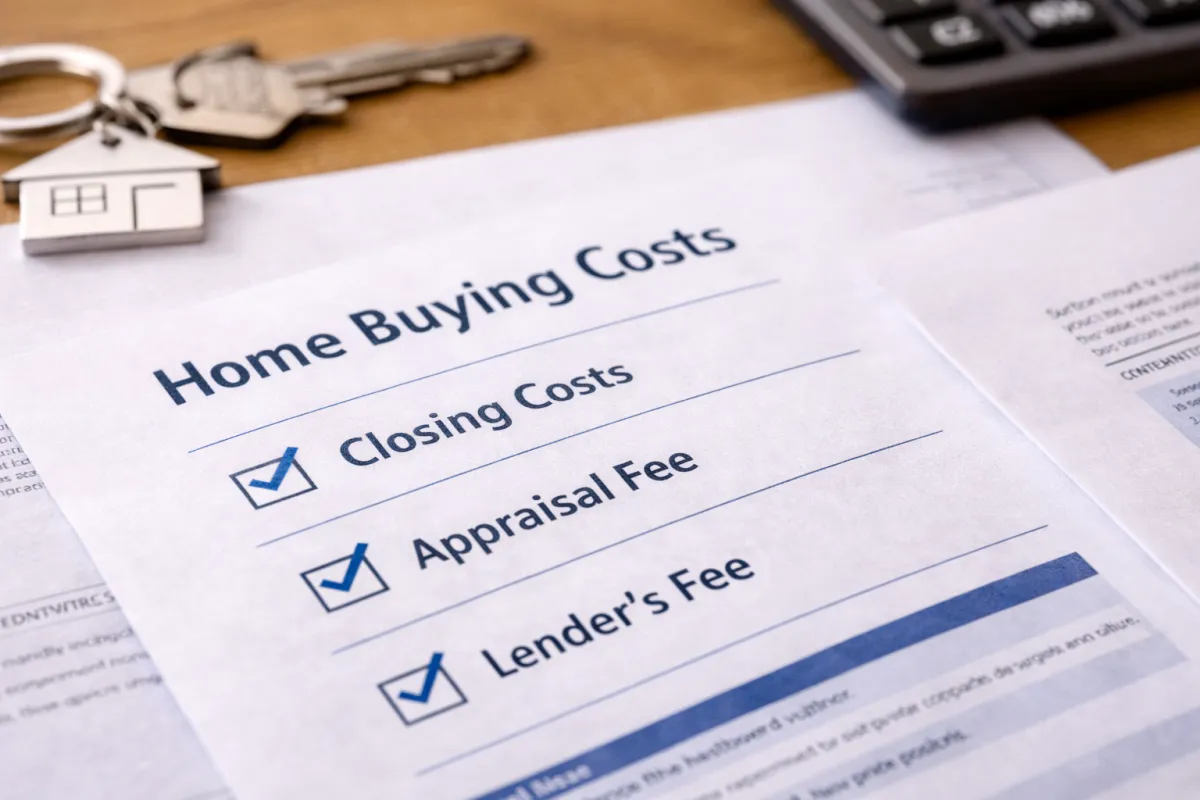
Beyond the down payment, first-time buyers in California should plan for closing costs, inspection fees, an appraisal, moving expenses, immediate home setup costs, and a repair cushion. Most of these are due before or at the time of closing, not after.
Getting surprised by them in the middle of escrow is one of the most stressful things I see buyers go through. All of it is avoidable if someone tells you what is coming before you open escrow.
That is what this article is for.
Closing Costs
This is the one that surprises buyers the most because it is the largest and the least understood.
Closing costs are separate from your down payment. Completely separate. They are a second bucket of money that covers the fees and prepaid expenses required to complete the transaction. Lender fees, title insurance, escrow fees, recording fees, prepaid property taxes, prepaid homeowners insurance, and prepaid mortgage interest are all line items that show up on your closing disclosure.
In California, closing costs typically run between 2 and 3 percent of the loan amount. On a $700,000 loan that is $14,000 to $21,000. On a $900,000 loan you are looking at $18,000 to $27,000. That is real money that needs to be liquid and ready.
Some of that can be negotiated into the transaction. Sellers can agree to cover a portion of your closing costs as part of the deal. Down payment assistance programs sometimes cover closing costs in addition to the down payment. But neither of those is guaranteed and you cannot count on them until they are confirmed in writing.
The best move is to assume you are paying your own closing costs and be pleasantly surprised if you get help. Going in assuming the seller will cover them and then finding out they will not is a harder position to recover from.
The Appraisal
The appraisal is ordered by your lender during escrow and the buyer pays for it. In California right now, appraisal fees typically run between $600 and $1,000 depending on the property type and location. It is due during the escrow process, not at closing, and it is not refundable if the deal falls apart.
What a lot of buyers do not realize is the appraisal protects them as much as the lender. The lender will not loan more than the appraised value of the home. So if you are paying $750,000 for a home that appraises at $730,000, you either need to renegotiate the price, cover the $20,000 gap out of pocket, or walk away. Knowing the home's real value before you are locked in is valuable information.
Budget for the appraisal as a separate line item, not something you assume is included somewhere else.
Home Inspections
Most buyers know inspections exist. Most underestimate how many there might be and what they collectively cost.
A general home inspection on a single family home in the SGV typically runs $400 to $600. That covers the basic structural, mechanical, and safety review. But depending on what the general inspector finds or what the home's age and condition suggest, you may also end up ordering a roof inspection, a sewer scope, a pest and termite inspection, a chimney inspection, or a foundation inspection.
Each of those is a separate cost ranging from $150 to $400. If you need three or four of them, you are looking at $1,000 to $2,000 in inspection fees on top of the general inspection.
All of these are paid upfront during escrow, before the deal closes. If the deal falls apart for any reason, you do not get that money back. That is not a reason to skip them. It is a reason to budget for them properly so the cost is not a shock.
Moving Expenses
Moving always costs more than people think it will.
A local move within the San Gabriel Valley using professional movers typically runs $1,000 to $3,000 depending on how much you have and how far you are going. If you are moving from further away or have a larger household, it goes up from there. Add boxes, packing materials, time off work if needed, and the random last-minute purchases that come with every move and you can easily be looking at $2,000 to $4,000 total.
People moving from a small apartment think it will be cheap. It is almost never as cheap as they expect. Build a real number into your budget, not a hopeful one.
Home Setup Costs
The day you get the keys is not the day the spending stops. It is the day a different kind of spending starts.
Window coverings alone can run $500 to $2,000 depending on the number of rooms and what you choose. New locks or a re-key, which we talked about in the first week homeowner article, runs $100 to $300. A basic set of tools if you do not already have them, a garden hose, a trash can for every room, lightbulbs, cleaning supplies, a toilet brush for each bathroom. None of these are expensive individually. All of them hit at once the first week.
Plan for $1,500 to $3,000 in immediate home setup costs, more if you are coming from a furnished rental and need to buy major appliances or furniture.
A Repair Cushion
Even well-maintained homes need something fixed after move-in.
It might be a minor issue the inspector flagged that you agreed to accept as-is. It might be something that shows up the first week that nobody caught. It might be the outlet that stops working or the bathroom fan that sounds like a helicopter. Small stuff, but real stuff.
Home maintenance experts generally recommend having one percent of the home's value set aside as a reserve for repairs and maintenance annually. On a $750,000 home that is $7,500 a year. You do not need all of that liquid on day one, but having $2,000 to $3,000 set aside as a repair cushion when you move in means the first inevitable fix does not send you into a panic.
Why This Matters More Than Most Buyers Realize
The buyers who go into their purchase knowing these costs exist are calmer, make better decisions, and close without the kind of stress that comes from being surprised by money you did not know you needed.
The buyers who find out about closing costs two weeks before closing, or who drain every dollar for the down payment and have nothing left for moving and setup, are the ones who feel like the process is happening to them instead of one they are in control of.
None of these costs are unreasonable. None of them should derail a well-planned purchase. They just need to be on your radar from the beginning, not the end. If you are still working out how much home you can afford in the first place, the income qualification article walks through that math in detail.
Armando Novelo, NMLS 237243, is a mortgage loan officer at Super Mortgage Bros, powered by Golden Empire Mortgage. He has been helping Southern California buyers and homeowners since 2002. His office is located in West Covina, CA.
For more info, join my email list.
Article Published: May 14, 2026

Links
Contact
Armando Novelo
NMLS 237243
Super Mortgage Bros
1900 W. Garvey Ave S. #100
West Covina, CA 91790
Phone: (626) 200-1838
I agree to be contacted by Super Mortgage Bros via call, email and text. To opt out, you can reply “stop” at any time or click the unsubscribe link in the emails. Message and date rates may apply.
Message frequency varies
© 2026 Super Mortgage Bros. Super Mortgage Bros. | All Rights Reserved | Licensed by the Department of Financial Protection and Innovation under the California Residential Mortgage Lending Act. Golden Empire Mortgage, Inc. ("GEM") [NMLS ID No. 2427] is a California corporation whose principal business office is located at 1200 Discovery Drive, Ste. 300, Bakersfield, California 93309. GEM is a residential mortgage lender and servicer Licensed by the Department of Financial Protection and Innovation under the California Residential Mortgage Lending Act. under license no. 413-0360. https://www.nmlsconsumeraccess.org